

 English
  русский
  Español
What Is Nonwoven Fabric: Polypropylene Types, Water Resistance and PP Bags
Home / News / Industry News / What Is Nonwoven Fabric: Polypropylene Types, Water Resistance and PP Bags
Content
A nonwoven fabric is a sheet or web of fibers bonded together by mechanical, thermal, or chemical means — without weaving, knitting, or any interlacing of individual yarns. The definition from INDA (the Association of the Nonwoven Fabrics Industry) describes nonwovens as engineered fibrous assemblies that are neither woven nor knitted and that have not been converted into yarn as an intermediate step. The fibers are laid down in a web — randomly, directionally, or in layers — and then consolidated into a coherent sheet structure.
The bonding method determines the final structure's properties as much as the fiber type does. Thermally bonded nonwovens are fused by heat — either through calendering (hot rollers that melt fiber intersections) or through-air bonding (hot air flowing through the web). Chemically bonded nonwovens use binder resins applied by saturation, spraying, or printing. Mechanically bonded types include needle-punched fabrics (barbed needles physically entangle fibers) and hydroentangled (spunlace) fabrics, where high-pressure water jets interlock the fiber web without any binder. Each method produces a fabric with distinct strength, softness, permeability, and cost characteristics suited to different end uses.
Nonwoven fabrics are one of the fastest-growing segments of the global textile industry, with applications spanning single-use medical and hygiene products, durable geotextiles and construction filtration, automotive interiors, agricultural crop covers, and reusable shopping bags. The global nonwoven fabrics market exceeded USD 50 billion in 2023 and continues to grow, driven by hygiene product demand, infrastructure investment, and the shift away from single-use plastics in packaging.
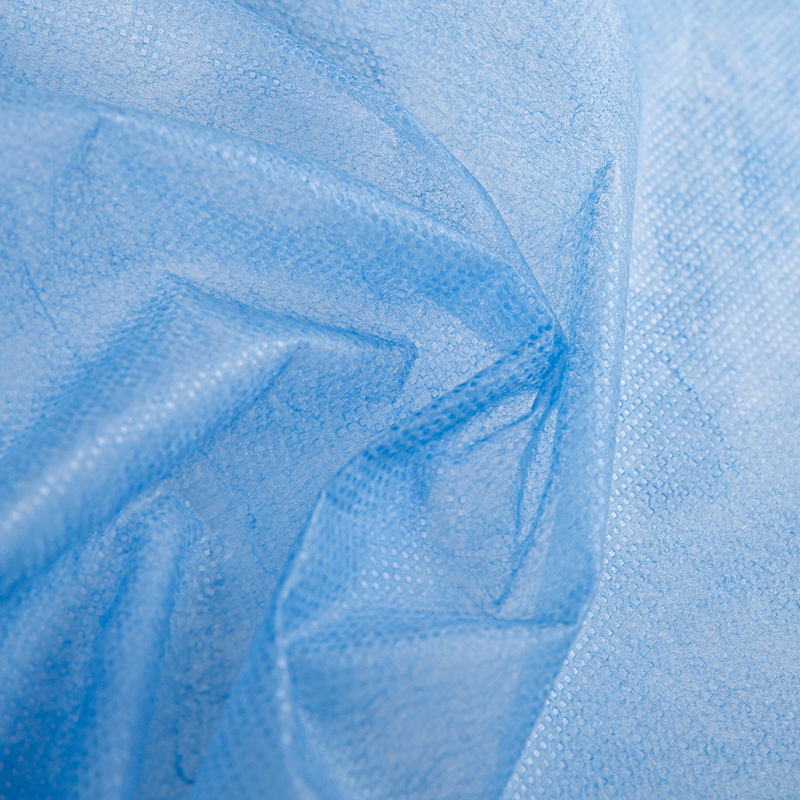
The structural difference between woven and nonwoven fabrics is fundamental, and it drives nearly every difference in their properties and applications.
A woven fabric is produced on a loom by interlacing two perpendicular sets of yarns — warp (lengthwise) and weft (crosswise) — in a defined repeating pattern. The crimp created where yarns cross gives woven fabrics their characteristic dimensional stability, consistent hand, and anisotropic strength (stronger along the yarn axes, weaker on the bias). Woven fabrics require the intermediate steps of fiber spinning into yarn and then yarn interlacing on a loom, making them more process-intensive and generally more expensive per unit area than nonwovens.
A nonwoven fabric goes directly from fiber or polymer to finished sheet, skipping both spinning and weaving. This direct conversion is why nonwovens are economically viable at very low basis weights — 10–20 g/m² polypropylene spunbond used in medical drapes and crop covers could not be produced economically as a woven fabric. The trade-off is that most nonwovens have lower tensile strength for their weight than woven fabrics, limited stretch recovery, and — in many constructions — less surface durability under abrasion.
| Property | Woven Fabric | Nonwoven Fabric |
|---|---|---|
| Structure | Interlaced warp and weft yarns | Bonded fiber web |
| Intermediate steps | Fiber → yarn → weaving | Fiber or polymer → sheet |
| Tensile strength | High (along yarn axes) | Moderate; varies by bonding |
| Minimum practical weight | ~80–100 g/m² | 10–20 g/m² achievable |
| Cost per unit area | Higher | Lower |
| Edge fraying | Yes (requires finishing) | No |
| Typical durability | High; suitable for long-term use | Variable; from single-use to durable |
Polypropylene (PP) nonwoven fabric is the dominant material in global nonwoven production, accounting for approximately 60% of all nonwoven fabric output by weight. It is produced primarily by the spunbond process: polypropylene resin pellets are melted in an extruder and forced through fine spinnerets to form continuous filaments, which are laid onto a moving conveyor belt in a random web pattern and then thermally bonded — typically by a heated calender roll that spot-welds the filaments at their crossing points without melting the full web. The result is a cohesive fabric produced in a single integrated production line from raw polymer to finished roll, without any intermediate fiber or yarn stage.
The properties of spunbond polypropylene nonwoven are well matched to a wide range of applications: it is lightweight (typical basis weights range from 10 to 150 g/m²), chemically inert, resistant to most acids, alkalis, and solvents, dimensionally stable, and can be produced in widths up to 5 meters on commercial lines. Its melting point of approximately 160°C means it withstands sterilization processes but cannot be ironed directly. Polypropylene has a density of 0.91 g/cm³ — lower than water — which means PP fabric and products float and are easily recyclable when separated from other materials.
PP nonwoven is also produced by the meltblown process, which forces molten polypropylene through much finer die orifices and draws the filaments with high-velocity hot air to produce extremely fine microfibers (1–5 microns diameter, vs 15–35 microns for spunbond). Meltblown PP has much smaller pore sizes and is used as the filtration layer in N95 respirators and surgical masks. SMS (spunbond-meltblown-spunbond) composites layer a soft, strong spunbond outer layer with a meltblown filtration core to combine structural integrity with barrier performance — the standard construction for disposable medical gowns, drapes, and hygiene covers.
Polypropylene is inherently hydrophobic — its non-polar molecular structure has no affinity for water, and water does not wet or penetrate PP fiber surfaces under normal conditions. This intrinsic hydrophobicity means that PP nonwoven fabric resists water penetration at the fiber level. However, whether a PP nonwoven fabric is effectively waterproof in use depends on its construction — specifically, the pore size between fibers relative to the pressure of water against the fabric surface.
Standard spunbond PP nonwoven (used in bags, hygiene covers, and agricultural films) is water resistant but not fully waterproof under hydrostatic pressure. It will repel light splash and light rain but will allow water to penetrate under sustained pressure or when immersed, because the inter-fiber pore spaces — while small — are not sealed. The hydrostatic head resistance of typical 40–80 g/m² spunbond PP is 50–200 mm, compared to 1,000–10,000 mm for a fully waterproof woven fabric with a polyurethane membrane laminate.
Truly waterproof nonwoven fabric is achieved through additional processing: laminating a polyethylene (PE) film to the PP spunbond backing creates a composite with zero liquid penetration at the film layer while retaining the soft, fabric-like surface of the nonwoven face. This PE-laminated PP nonwoven construction is standard for disposable medical table covers, waterproof mattress protectors, and agricultural mulch films where liquid barrier performance is required alongside the cost and handling advantages of nonwoven structure. Alternatively, the spunbond web can be coated with a water-repellent finish (fluorocarbon or silicone-based) to enhance surface repellency without full waterproofing — suitable for applications where breathability must be maintained alongside water resistance, such as protective coveralls and crop covers.
Polypropylene nonwoven bags — the stiff-sided, brightly printable reusable bags widely used as grocery totes, promotional bags, and retail shopping bags — are made from spunbond PP nonwoven fabric, typically in the 70–120 g/m² weight range, cut and sewn or ultrasonically welded into bag form. They became prominent as an alternative to single-use plastic bags and have been widely adopted by retailers globally as a branded, reusable packaging solution.
The practical properties that make spunbond PP well suited to bag applications are its stiffness (the thermally bonded structure holds shape without a frame), excellent printability (surface accepts solvent and water-based inks for high-quality graphics), low weight, and cost. A standard 80 g/m² PP nonwoven grocery bag weighs approximately 50–70 grams and can carry loads of 5–10 kg without tearing when the seams are properly reinforced — load capacity depends primarily on seam construction and handle attachment method rather than the fabric tensile strength.
PP nonwoven bags are marketed as reusable and recyclable, but both claims require qualification. Reusability is genuine — studies have found that PP nonwoven bags have a usable life of 50–100 uses under normal retail conditions before handle or seam failure. The environmental break-even point versus single-use LDPE plastic bags (in terms of total life-cycle impact) is typically cited as 8–12 uses, meaning bags used consistently for a season or more deliver a net environmental benefit. Recyclability is technically possible — PP is a widely recycled polymer — but in practice, the bag format, fabric weight, and mixed-material construction (fabric plus handles plus any laminate or reinforcement) make sorting and processing in standard recycling streams difficult. Dedicated PP textile recycling programs exist in some markets but are not universally available.
Beyond retail shopping bags, PP nonwoven bag applications include agricultural seed and fertilizer sacks, industrial bulk packaging (big bags / FIBCs use woven PP, but smaller nonwoven sacks are used for food-grade and hygiene-sensitive contents), medical waste bags, and promotional tote bags for events, trade shows, and brand marketing.
In garment production, interlining defects surface late and cost money: a collar that bubbles after fusing, a lapel th...
READ MOREPlain spunbond polypropylene fabric slides. On a high-speed bag cutting line that means off-square panels, misaligned ...
READ MOREAt a packaging plant in eastern China, switching reusable shopping-bag production from woven polypropylene to PP spunb...
READ MOREWhen a surgical mask specification requires a filtration layer that stops sub-micron particles, or an HVAC filter desi...
READ MOREAn N95 respirator and a reusable shopping bag are both made from polypropylene nonwoven, yet one captures 95 percent o...
READ MORE




