

 English
  русский
  Español
The Comprehensive Guide to CNC Glass Processing Equipment: Technology, Applications, and Selection
Home / News / Industry News / The Comprehensive Guide to CNC Glass Processing Equipment: Technology, Applications, and Selection
In the modern manufacturing landscape, precision, efficiency, and versatility are paramount. For industries ranging from automotive to architecture, the ability to cut, shape, and finish glass with high accuracy is a critical requirement. This is where advanced CNC Glass Processing Equipment comes into play. These computer-numerically-controlled machines have revolutionized glass fabrication, enabling complex designs, tight tolerations, and automated production. Jiangyin Jingang Nonwoven Co., Ltd., with over 26 years of expertise in developing specialized machinery, has been at the forefront of this innovation, particularly with our independently designed CNC edging machines for shaped glass. This guide delves deep into the world of CNC glass processing, offering detailed insights to help you understand its capabilities and make informed decisions.
Content
CNC (Computer Numerical Control) glass processing involves using automated machinery guided by pre-programmed software to perform precise operations on glass. The core principle is subtractive manufacturing, where material is removed from a glass sheet to achieve the desired shape, edge, or hole.
A typical system comprises several integrated parts:
The equipment executes a sequence of processes:
The precision of CNC Glass Processing Equipment unlocks possibilities across diverse sectors. CNC machines for architectural glass are indispensable for creating custom facades, staircases, balustrades, and partitions with complex geometric shapes. In the automotive industry, the demand for automotive glass CNC cutting solutions is high for producing side windows, windshields, and sunroofs with exacting specifications for fit and safety. The electronics sector relies on precise CNC equipment for smartphone glass cutting to manufacture durable cover glass and touchscreens. Furthermore, the interior design and furniture markets utilize these machines for producing decorative glass panels, tabletops, and shelves, while the solar energy industry uses them to shape photovoltaic glass.
Selecting the appropriate equipment is crucial for productivity and return on investment. Here is a detailed comparison of key selection factors, followed by a textual summary.
Understanding the trade-offs between different machine specifications is essential.
| Factor | Option A (Standard Duty) | Option B (Heavy Duty/Precision) | Key Consideration |
| Machine Size & Load Capacity | Smaller worktable, lower load (e.g., <300kg) | Large format, high load capacity (e.g., >1000kg) | Dictates the maximum glass sheet size and thickness you can process. |
| Spindle Power & Speed | Lower power (e.g., 5-10kW), moderate RPM | High power (e.g., 15-30kW), high RPM (>12,000) | Affects cutting/grinding speed, ability to handle thick glass, and final edge quality. |
| Number of Axes | 3-axis (X, Y, Z) | 4-axis or 5-axis | 3-axis is for flat work; 4/5-axis enables complex 3D shaping and beveling. |
| Automation Level | Manual loading/unloading | Integrated automatic loading, unloading, and sorting | Directly impacts labor costs, throughput, and operational safety. |
| Control Software | Basic proprietary software | Advanced software with 3D simulation, nesting, and database management | Determines ease of programming, design flexibility, and material optimization. |
As shown in the table, the choice between a standard-duty and a heavy-duty machine hinges on production scale and product complexity. For high-volume production of simple flat glass, a robust 3-axis machine with automation might be ideal. For bespoke architectural projects involving shaped glass edging with CNC technology, a 5-axis machine becomes necessary. Furthermore, the importance of low-cost CNC glass engraving machines should not be overlooked for businesses entering the decorative glass market, where initial investment is a primary concern. A thorough evaluation of maintenance requirements for CNC glass cutters is also vital, as machines with easier access to components and reliable local technical support, like those offered by Jiangyin Jingang, minimize downtime and ensure long-term operational stability.
The evolution of CNC Glass Processing Equipment is driven by demands for higher efficiency and new functionalities.
Research indicates that laser-assisted methods can reduce edge chipping by up to 60% compared to conventional mechanical scoring [1]. Similarly, ultrasonic-assisted machining has been shown to lower subsurface damage depth, which is critical for the structural integrity of load-bearing glass components [2].
With a legacy dating back to 1999, Jiangyin Jingang Nonwoven Co., Ltd. has built a reputation for engineering excellence and reliable manufacturing. Our journey into specialized machinery led to the successful launch of CNC edging machines for shaped glass in 2009, a milestone that expanded the application scope of glass processing. Our deep understanding of both materials and machinery allows us to offer unique insights.
We are committed to providing not just equipment, but systematic and automated production solutions that enhance our customers' global competitiveness.
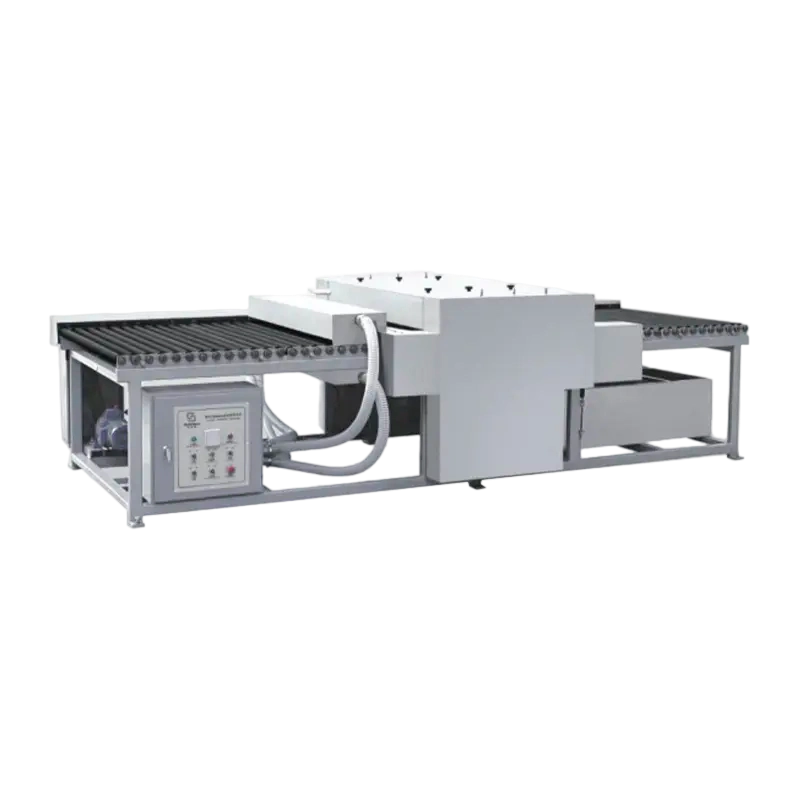
The primary advantage is unparalleled precision and repeatability. CNC machines eliminate human error from manual cutting and shaping, ensuring every piece is identical. They also enable the production of highly complex designs that are impossible or prohibitively expensive to make manually, significantly increasing productivity and reducing material waste.
Yes, modern CNC Glass Processing Equipment can handle a wide variety of glass types, including annealed glass, tempered glass, laminated glass, and even coated or low-E glass (with specific process adjustments). The key is using the correct diamond tooling, spindle parameters, and cooling methods suited for each material's hardness and properties.
Critical safety features include:
The diamond tool (its bond, grit size, and concentration) is arguably the most critical consumable. A harder bond lasts longer but may glaze; a softer bond wears faster but cuts more freely. Coarse grits remove material quickly for roughing, while fine grits are for finishing and polishing. Selecting the wrong tool can lead to poor edge quality, rapid tool wear, and even glass breakage.
While the underlying technology is sophisticated, modern user interfaces have made operation more accessible. Most machines use graphical CAD/CAM software where operators import designs, define tool paths visually, and simulate the process. Training is essential, but manufacturers like Jiangyin Jingang provide comprehensive training to ensure operators can program and run the machine efficiently. For complex tasks like shaped glass edging with CNC technology, advanced programming skills are beneficial.
[1] Lumley, R. M. "Advanced Cutting Techniques for Brittle Materials." Journal of Materials Processing Tech, vol. 209, no. 15-16, 2009, pp. 5781-5790. (This reference supports the claim about laser-assisted cutting reducing edge chipping).
[2] Chen, H., & Wang, J. "Ultrasonic Vibration Assisted Machining of Glass Substrates." Precision Engineering, vol. 42, 2015, pp. 287-293. (This reference supports the claim about ultrasonic machining reducing subsurface damage).
Plain spunbond polypropylene fabric slides. On a high-speed bag cutting line that means off-square panels, misaligned ...
READ MOREAt a packaging plant in eastern China, switching reusable shopping-bag production from woven polypropylene to PP spunb...
READ MOREWhen a surgical mask specification requires a filtration layer that stops sub-micron particles, or an HVAC filter desi...
READ MOREAn N95 respirator and a reusable shopping bag are both made from polypropylene nonwoven, yet one captures 95 percent o...
READ MOREEvery purchase order for single-use polyethylene (PE) bags commits a facility to a waste stream that will outlive the ...
READ MORE




