

 English
  русский
  Español
What Is Non Woven Fabric? Definition, Production, Materials & Industry
Home / News / Industry News / What Is Non Woven Fabric? Definition, Production, Materials & Industry
Content
Non woven fabric is a sheet or web of fibers bonded together by mechanical, thermal, or chemical means — without the interlacing of yarns that defines woven or knitted textiles. The term itself is a technical distinction: where conventional fabric construction requires spinning raw fibers into yarn and then interlacing those yarns on a loom, non woven production bypasses both steps entirely, converting fiber or polymer directly into a functional fabric in a single continuous process.
The official definition from the International Nonwovens and Disposables Association (INDA) and EDANA (the European non wovens industry association) describes non wovens as engineered fibrous assemblies, made from fibers, filaments, or films, that are bonded together by friction, cohesion, or adhesion — explicitly excluding paper (which uses plant-cell bonding) and fabrics that have been woven, knitted, tufted, or stitch-bonded using yarns or filaments. This distinction matters commercially because non woven fabrics are classified separately from traditional textiles in trade statistics, regulatory frameworks, and material specifications worldwide.
Non woven fabrics can be engineered to be soft or stiff, absorbent or repellent, biodegradable or durable, disposable or reusable — properties tuned by selecting the fiber type, web formation method, and bonding technology. This design flexibility, combined with high-speed continuous manufacturing that does not require yarn spinning or weaving infrastructure, makes non wovens one of the fastest-growing segments of the global textile industry. Global non woven fabric production exceeded 12 million metric tons in 2023, with applications spanning hygiene products, medical textiles, geotextiles, filtration, construction, and automotive components.
The raw material selection is the most fundamental variable in non woven design, determining the fabric's base performance characteristics before any bonding or finishing process is applied. Non woven fabrics are produced from both synthetic polymers and natural fibers, and increasingly from recycled or bio-based materials as sustainability targets reshape industry procurement.
Non woven manufacturing involves two sequential stages: web formation (arranging fibers into a flat sheet or web) and bonding (consolidating the web into a coherent fabric with the required strength and integrity). The combination of web formation method and bonding technology defines the fabric's structure and performance characteristics more precisely than any other production variable.
Spunbond is the most widely produced non woven technology globally, accounting for the largest single share of non woven volume. The process converts polymer granules — predominantly polypropylene — directly into finished fabric in a single inline operation: polymer is melted, extruded through spinnerets into continuous fine filaments, drawn by high-velocity air to orient and attenuate the filaments, laid randomly onto a moving collector belt to form a web, and then thermally bonded using calender rolls to consolidate the web into fabric.
The entire sequence from polymer chip to finished fabric roll occurs without any intermediate fiber or yarn stage, giving spunbond production lines exceptional speed — modern lines run at 400–600 meters per minute — and cost efficiency. Fabric weights range from 8 gsm (grams per square meter) for lightweight hygiene facings to 150+ gsm for heavier geotextile and construction applications.
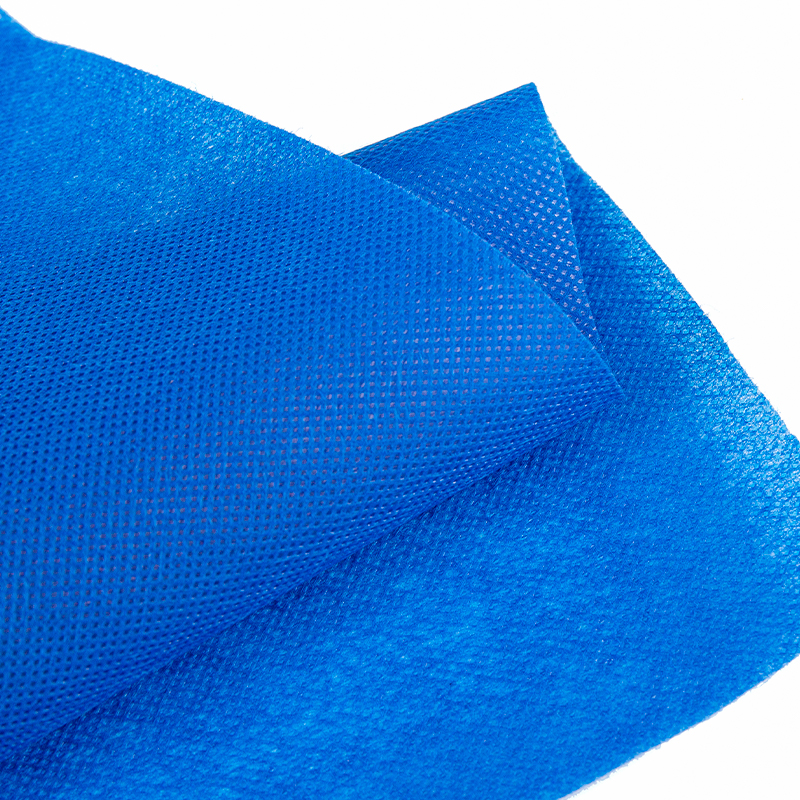
Spunbond PP fabric is the foundational material in disposable hygiene products — the topsheet and backsheet of baby diapers, the cover stock of feminine pads and adult incontinence products, and the outer layers of surgical gowns. It is also the primary material in reusable shopping bags, crop protection covers, and medical sterilization wrap. The familiar blue or white material used in disposable face masks is a three-layer SMS (Spunbond–Meltblown–Spunbond) composite, where the middle meltblown layer provides fine fiber filtration while the outer spunbond layers provide structural integrity and softness.
Meltblown — a closely related spunlaid process — produces much finer filaments (1–5 microns versus 15–25 microns for spunbond) by using very high-velocity hot air to attenuate the extruded polymer into microfibers. Meltblown layers provide filtration efficiency for particles and bacteria; spunbond layers provide the strength and durability that meltblown alone cannot. SMS and SMMS laminates combining these two technologies are the industry standard for medical and protective non wovens.
The distinction between woven and non woven fabrics goes beyond manufacturing process — it shapes the mechanical behavior, aesthetic properties, recyclability, and appropriate applications of the resulting material.
Woven fabric is constructed by interlacing two sets of yarns — the warp (running lengthwise) and the weft (running crosswise) — at right angles on a loom. The interlaced structure gives woven fabrics their characteristic properties: defined grain direction, fray-prone cut edges, high tensile strength along the yarn axes, and the ability to be unraveled back to individual yarns. Woven fabrics are inherently anisotropic — stronger along their yarn directions than diagonally — and their mechanical properties are tightly linked to yarn count, weave pattern, and fiber type.
Non woven fabric, by contrast, has no yarn structure. Its fibers are randomly or directionally oriented and held together by bonding rather than interlacing. This produces a material that is more isotropic in the plane of the fabric, does not fray when cut, can be produced in a continuous web at high speed, and can be engineered with highly specific porosity, weight, and surface characteristics impossible to achieve in woven construction.
| Property | Woven Fabric | Non Woven Fabric |
|---|---|---|
| Structure | Interlaced yarns | Bonded fiber web |
| Edge behavior when cut | Frays | Does not fray |
| Tensile strength | High (yarn-axis dependent) | Moderate (more uniform in-plane) |
| Production speed | Slower (requires spinning + weaving) | Very high (direct fiber-to-fabric) |
| Washability / durability | Generally higher | Varies — from single-use to multi-year |
| Cost per unit area | Higher | Lower (high-volume applications) |
| Aesthetic / drape | Superior for apparel | Functional; improving with technology |
Landscape fabric — also called weed barrier, ground cover fabric, or geotextile mulch — is one of the most commercially visible applications where woven and non woven technologies compete directly in the same product category, and the choice between them has significant practical consequences for garden and horticultural performance.
Woven landscape fabric is made from flat-tape PP strips interlaced in a grid pattern. The open weave structure provides excellent water permeability and airflow — water passes through the grid openings freely, reaching plant roots — while the continuous tape construction delivers high tensile strength and tear resistance. Woven fabric lies flat, is easy to cut and pin, and can withstand foot traffic and equipment loads in commercial landscaping applications. It is the preferred choice for long-term weed suppression under gravel paths, driveways, and permanent planting beds where the fabric will remain in place for 10–25 years.
Non woven landscape fabric is typically a needlepunched or thermally bonded PP or PET fabric. Its random fiber structure creates a denser, more uniform barrier that blocks weed seedling emergence more effectively than the grid openings of woven fabric at equivalent weight. It also retains soil particles better — useful on slopes or in mulched beds where fine soil would otherwise migrate through woven gaps. However, non woven landscape fabric compacts over time under soil pressure and organic matter accumulation, gradually reducing water permeability — a limitation that becomes significant in beds receiving regular irrigation or heavy rainfall.
A practical guideline for selection: use woven fabric under hard landscaping (gravel, rock, pavers) where long-term structural integrity and drainage performance outweigh weed suppression uniformity; use non woven fabric in planting beds where denser weed blocking and soil retention matter more in the short to medium term, accepting that it may need replacement after 3–7 years as compaction reduces effectiveness.
The non woven textile industry occupies a distinct position in the broader materials landscape — it intersects with traditional textiles, technical materials, disposable products, and advanced composites, serving end markets that range from mass-consumption hygiene to precision filtration and high-performance automotive engineering. Understanding the industry's structure helps manufacturers, specifiers, and buyers navigate a complex and rapidly evolving supply chain.
Asia Pacific — led by China — accounts for over 50% of global non woven production capacity, with China alone home to hundreds of spunbond and needlepunch lines. The region's dominance reflects both domestic demand from the world's largest hygiene and medical product markets and its role as the primary export manufacturing base for non woven roll goods and converted products. Europe and North America remain significant in high-value technical segments, including automotive, specialty filtration, and medical-grade fabrics, where quality certification requirements and proximity to end-users offset production cost differentials.
Plain spunbond polypropylene fabric slides. On a high-speed bag cutting line that means off-square panels, misaligned ...
READ MOREAt a packaging plant in eastern China, switching reusable shopping-bag production from woven polypropylene to PP spunb...
READ MOREWhen a surgical mask specification requires a filtration layer that stops sub-micron particles, or an HVAC filter desi...
READ MOREAn N95 respirator and a reusable shopping bag are both made from polypropylene nonwoven, yet one captures 95 percent o...
READ MOREEvery purchase order for single-use polyethylene (PE) bags commits a facility to a waste stream that will outlive the ...
READ MORE




