

 English
  русский
  Español
Woven vs Non Woven Geotextile Fabric: Key Differences & How to Choose
Content
What Does Non Woven Mean?
Non woven refers to a fabric or textile structure produced by bonding or entangling fibers together through mechanical, thermal, or chemical processes — without weaving or knitting. Unlike traditional fabrics, non woven materials are engineered directly from raw fibers or filaments, making them faster and more cost-effective to manufacture at scale.
The term originates from the textile industry's need to differentiate sheet-like fiber assemblies from conventional woven cloth. In a non woven fabric, individual fibers are laid down in a random or oriented web and then bonded — for example, through needle-punching, heat calendering, or resin saturation. The result is a cohesive sheet that can mimic many functions of woven fabric while offering unique structural properties of its own.
Non woven materials are used across dozens of industries: medical gowns, surgical masks, disposable hygiene products, agricultural covers, filtration media, roofing underlays, and — most relevant to civil engineering — geotextile fabrics. Their ability to be engineered for specific permeability, strength, and elongation characteristics makes them especially valuable in infrastructure and construction applications.
How Non Woven Geotextiles Are Made
Non woven geotextiles are manufactured primarily from polypropylene or polyester staple fibers or continuous filaments. The two dominant production methods are:
- Needle-punched non wovens: Fiber webs are mechanically entangled using thousands of barbed needles per minute. This creates a dense, three-dimensional fiber matrix with high porosity and excellent drainage capacity. Needle-punched fabrics are the most common type used in geotechnical applications.
- Heat-bonded (thermally bonded) non wovens: Fibers are bonded at their cross-points using heat and pressure. The result is a stiffer, smoother fabric with more consistent pore sizes — often used where controlled filtration is critical.
The manufacturing process allows engineers to control weight (measured in grams per square meter, or GSM), tensile strength, elongation at break, and apparent opening size (AOS) — the pore size that determines what soil particles the fabric will retain.
Woven vs Non Woven Geotextile Fabric: Key Differences
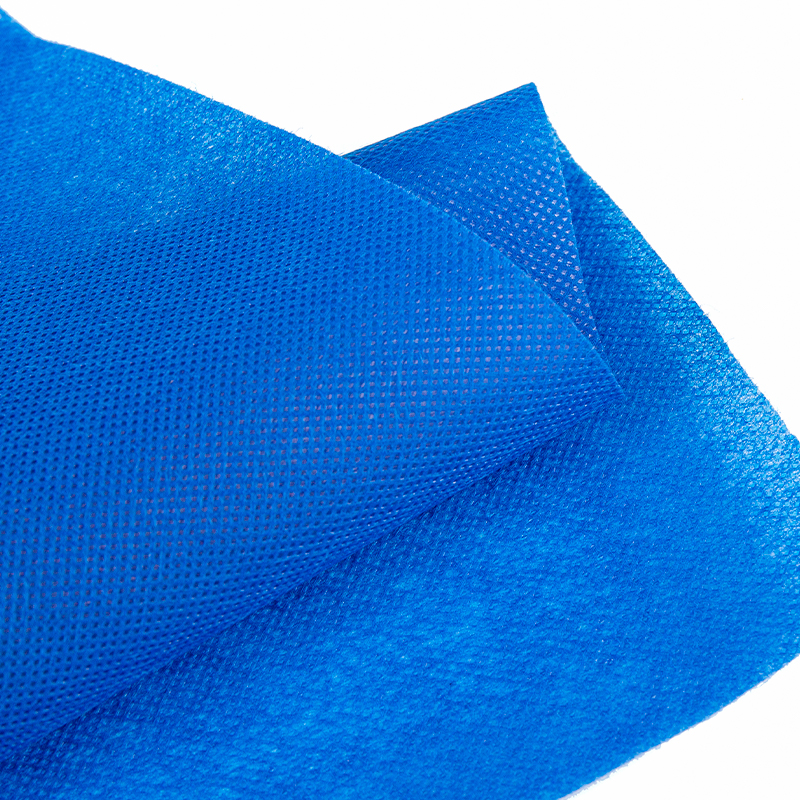
Woven geotextiles are manufactured by interlacing two sets of yarns (warp and weft) at right angles on a loom — the same fundamental process used to make canvas or burlap. The result is a fabric with a clearly visible grid-like structure. Non woven geotextiles, by contrast, have a felt-like appearance with fibers oriented in multiple directions.
| Property | Woven Geotextile | Non Woven Geotextile |
|---|---|---|
| Structure | Interlaced yarns (grid pattern) | Bonded/entangled fiber web |
| Tensile Strength | High — directional, excellent load-bearing | Moderate — more isotropic (multi-directional) |
| Elongation | Low (5–25%) | High (50–100%+), more conformable |
| Water Flow (Permeability) | Primarily planar (in-plane flow limited) | High cross-plane permeability — excellent drainage |
| Filtration | Limited — larger, more uniform openings | Superior — small, tortuous pore paths retain fine particles |
| Separation | Excellent — resists puncture and soil mixing | Good, especially in lighter traffic applications |
| Reinforcement | Primary choice for load transfer and stabilization | Secondary — used where confinement is needed |
| Cost | Generally higher per unit area | Often more economical, especially at high GSM |
Primary Functions: Where Each Type Excels
Geotextiles serve five core engineering functions: separation, filtration, drainage, reinforcement, and containment. The choice between woven and non woven depends on which function dominates in the application.
When to Use Woven Geotextile
- Road and railway subgrade stabilization: Woven fabrics with high tensile modulus distribute wheel loads across weak subgrades, preventing aggregate from migrating into soft soils. A typical specification might require 50–200 kN/m tensile strength at low strain.
- Retaining wall reinforcement: Geogrid-like woven textiles anchor back-fill soils in mechanically stabilized earth (MSE) walls.
- Erosion control with rip-rap: Under heavy stone armor, woven fabrics resist puncture while separating aggregate layers.
- Silt fences: Woven slit-film geotextiles are the industry standard for temporary sediment control on construction sites.
When to Use Non Woven Geotextile
- French drains and subsurface drainage systems: The three-dimensional fiber matrix of needle-punched non wovens allows water to pass freely in both cross-plane and in-plane directions while filtering out fine soil particles that would clog perforated pipes.
- Shoreline and riverbank protection: Non wovens conform readily to irregular slopes and provide effective filtration between soil and armor stone, preventing internal erosion (piping).
- Landfill leachate collection: High-GSM non wovens (300–600 g/m²) act as cushion layers protecting geomembranes from puncture while transmitting leachate to collection pipes.
- Pavement edge drains and pond liners: Their isotropic permeability ensures water moves efficiently regardless of installation orientation.
How to Select the Right Geotextile: A Practical Guide
Selecting between woven and non woven geotextile fabric involves evaluating several site-specific parameters:
- Define the primary function. If the dominant need is load transfer or tensile reinforcement, lean toward woven. If filtration or drainage dominates, non woven is typically the better choice.
- Characterize the soil. Determine the grain size distribution (D85 particle size) of the adjacent soil. This directly governs the required apparent opening size (AOS) of the geotextile — a key spec for non wovens used in filtration.
- Assess loading conditions. High point loads (from angular aggregate or construction traffic) favor woven fabrics with higher CBR puncture resistance. Conformance to uneven surfaces favors non wovens.
- Review design standards. Projects governed by AASHTO M288, ASTM D4751, or EN ISO 10319 will have prescriptive minimum property tables that narrow your selection quickly.
- Consider long-term chemical exposure. Both polypropylene and polyester geotextiles resist most soil chemicals, but polyester degrades in high-pH environments (>10), making polypropylene preferable near lime-stabilized fills or concrete.
In some applications — particularly heavy-haul road bases or large-scale drainage blankets — engineers specify a composite geotextile that combines a woven carrier fabric with a non woven filter layer, capturing the reinforcement benefit of both structures in a single product.
Understanding Geotextile Specifications and Testing Standards
Whether sourcing woven or non woven geotextile, buyers should request conformance data for the following standard tests:
- ASTM D4632 / EN ISO 10319 — Wide-width tensile strength and elongation
- ASTM D4751 — Apparent opening size (AOS / O95), critical for filtration design
- ASTM D4491 — Permittivity and permeability (water flow rate through the fabric)
- ASTM D6241 — CBR puncture resistance (index of resistance to aggregate intrusion)
- ASTM D4355 — UV degradation resistance (important for fabrics exposed before burial)
Mass per unit area (GSM) is a useful commercial indicator but is not a substitute for performance specifications. Two non woven fabrics of identical GSM can have very different AOS values and tensile profiles depending on fiber type, denier, and bonding method. Always specify by property, not weight alone.




