

 English
  русский
  Español
What Is Nonwoven Fabric? Types, Uses, and How It Compares to Woven Fabric
Home / News / Industry News / What Is Nonwoven Fabric? Types, Uses, and How It Compares to Woven Fabric
Content
Nonwoven fabric is a flat, flexible sheet material made directly from fibers or filaments bonded together by mechanical, thermal, or chemical means — without any weaving, knitting, or yarn formation involved. Where conventional textiles require fibers to first be spun into yarn and then interlaced through a loom or knitting machine, nonwovens skip both of those steps entirely: fibers go from raw material to finished fabric sheet in a single continuous manufacturing process.
The result is a material class with an exceptionally wide range of properties, depending on the fiber type, web formation method, and bonding technology used in production. Nonwovens can be engineered to be soft or stiff, absorbent or repellent, disposable or durable, opaque or translucent, permeable to air and water or fully barrier-forming. This versatility — combined with high production speeds and low material cost — is why nonwoven fabrics now appear in nearly every industry: healthcare, hygiene, agriculture, construction, automotive, filtration, packaging, and geotechnical engineering.
Global nonwoven fabric production exceeded 12 million metric tons per year as of recent industry data, with demand growing consistently at 6–8% annually. The largest volume applications are hygiene products (diapers, feminine care, adult incontinence), medical and surgical products, and geotextiles — each of which depends on specific combinations of properties that nonwovens deliver more cost-effectively than any alternative material.
Nonwoven manufacturing involves two sequential stages: web formation (creating a layer of loosely arranged fibers) and bonding (consolidating the web into a coherent fabric with structural integrity). The web formation method and the bonding method together determine the final fabric's structure, hand feel, strength, and performance characteristics.
The principal web formation technologies are spunbond (continuous filaments extruded directly from polymer melt and laid onto a moving belt), meltblown (polymer extruded through fine nozzles with high-velocity hot air to produce sub-micron fibers), drylaid (staple fibers carded or air-laid into a web), and wetlaid (fibers dispersed in water and deposited on a screen, similar to papermaking). Bonding methods include thermal bonding (heat and pressure fusing fibers at contact points), chemical bonding (binder latex applied to the web), hydroentanglement (high-pressure water jets mechanically entangling fibers), and needle punching (barbed needles mechanically interlocking fibers by repeated penetration).
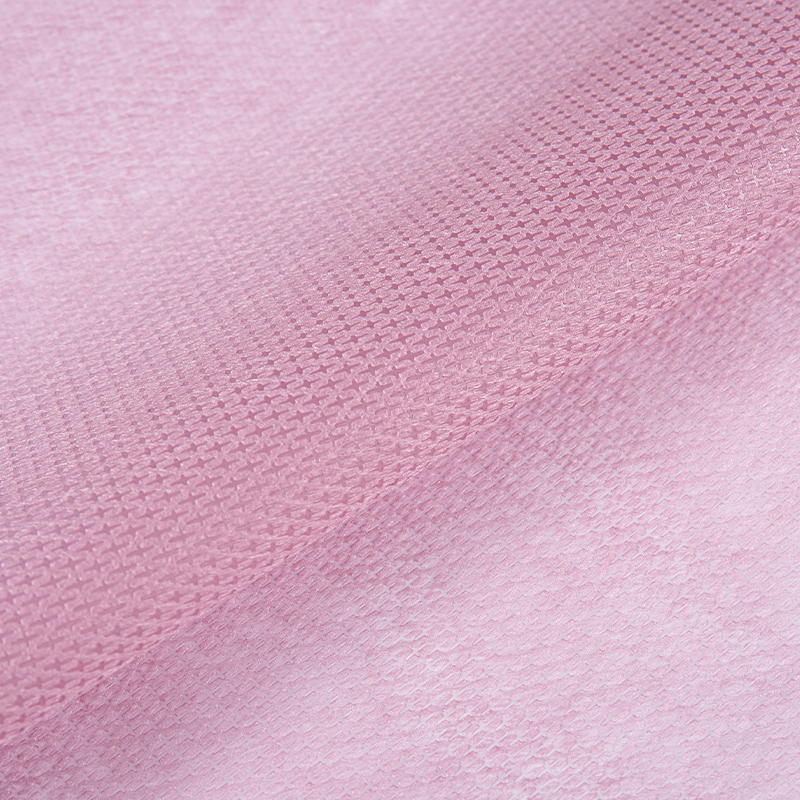
Among all nonwoven fabric types, spunbond polypropylene (PP spunbond) is the highest-volume product globally and the reference material against which other nonwovens are often benchmarked. Its dominance comes from the combination of polypropylene's low cost and excellent processing properties with the efficiency of the spunbond production process.
In spunbond production, polypropylene pellets are melted and extruded through a spinneret plate containing thousands of fine holes. The emerging filaments are drawn by high-velocity air to orient the polymer chains and reduce filament diameter — typically to 15–35 microns for standard spunbond, compared to 0.1–3 microns for meltblown. The continuous filaments are laid randomly onto a moving conveyor belt to form a web, which then passes through heated calendar rolls that thermally bond the filaments together at their crossing points. The finished fabric is wound into rolls for conversion or direct use.
The properties of PP spunbond are well-suited to a broad range of applications. Polypropylene is inherently hydrophobic — it repels water rather than absorbing it — which makes untreated spunbond fabric naturally resistant to liquid penetration. Surface treatments can reverse this: corona treatment or hydrophilic finish application renders the fabric absorbent for hygiene product topsheets and medical applications requiring fluid management. PP spunbond is also chemically inert to most acids, alkalis, and solvents; resistant to mold and bacterial growth; and fully recyclable within the polypropylene waste stream.
Fabric weight in PP spunbond is expressed in grams per square meter (gsm). Lightweight grades of 10–20 gsm are used for hygiene product components and agricultural crop covers. Medium weights of 25–60 gsm cover medical and surgical applications, protective apparel, and reusable shopping bags. Heavier grades of 80–200 gsm are used in geotextiles, construction membranes, and industrial filtration. A single spunbond production line can manufacture the full weight range by adjusting line speed, polymer throughput, and calendar pressure.
One of the most important product formats in medical and hygiene nonwovens is the SMS (Spunbond-Meltblown-Spunbond) laminate. SMS combines two outer layers of spunbond for strength and softness with an inner layer of meltblown for barrier performance. Meltblown PP fibers are so fine (often below 1 micron) that they create an extremely dense, tortuous fiber network capable of blocking bacteria, viruses, and fine particulates while remaining breathable. SMMS and SMMMS constructions add additional meltblown layers for enhanced barrier performance, and are the standard material in surgical gowns, drapes, and N95-equivalent respirator layers. The outer spunbond layers protect the fragile meltblown core from abrasion and provide the tensile strength required for garment construction and handling.
Woven and nonwoven fabrics are both flat textile structures, but their fiber architectures, manufacturing processes, performance profiles, and cost structures are fundamentally different. Choosing between them for a given application is not a matter of one being superior — each has clear areas of advantage.
| Property | Woven Fabric | Nonwoven Fabric |
|---|---|---|
| Fiber structure | Interlaced yarns at defined angles | Random or directional fiber web, bonded |
| Tensile strength | High; directional (warp/weft) | Moderate; more isotropic in random-laid webs |
| Tear resistance | High | Lower; tears propagate easily once initiated |
| Drape and hand | Excellent; suitable for apparel | Variable; typically stiffer than woven equivalents |
| Barrier performance | Limited without coating or membrane lamination | Excellent (SMS/meltblown constructions) |
| Filtration capability | Limited by yarn gap size | High; meltblown achieves sub-micron filtration |
| Production speed | Moderate | Very high (spunbond lines run at 300–600 m/min) |
| Material cost | Higher (yarn spinning adds cost) | Lower at equivalent weight |
| Washability / reuse | High; designed for repeated laundering | Mostly single-use; durable grades exist |
| Edge fraying | Yes; requires hemming or sealing | No; edges are inherently stable |
The most significant practical distinction is durability versus cost. Woven fabrics are engineered for repeated use — their interlaced yarn structure resists abrasion and maintains integrity through washing, folding, and mechanical stress over years of service. Nonwovens in most configurations are optimized for single-use or limited-use applications where the cost of the material must be low enough to justify disposal after use. This is not a limitation of the technology — it is the design intent. A disposable surgical gown that costs $0.80 and provides reliable barrier protection for one procedure is a better solution than a reusable woven gown requiring sterilization infrastructure costing multiples of that per cycle.
Durable nonwovens do exist — needle-punched geotextiles installed in road bases and drainage systems are designed for service lives of 25–50 years, and heavy spunbond PP agricultural fabrics are reused for multiple growing seasons. But the economic logic of nonwovens is most compelling in the single-use and limited-use segments where they have replaced woven alternatives almost entirely.
Medical and surgical end-uses represent one of the most demanding and highest-value segments of the nonwoven industry. The requirements are stringent: the fabric must provide reliable microbial barrier performance, be free of particles or contaminants that could compromise sterile fields, meet regulated standards for fluid resistance, and be comfortable for clinical staff wearing it for extended periods. Nonwovens — particularly SMS and SMMS polypropylene composites — meet all of these requirements at a cost that makes single-use disposal economically viable, which eliminates the recontamination risk associated with reusable woven surgical textiles.
Surgical gowns and operating field drapes made from SMS nonwoven are classified under EN 13795 (Europe) and AAMI PB70 (United States) standards, which define four performance levels based on fluid resistance and microbial barrier efficiency. Critical zones — the sleeves and chest of a surgical gown, the fenestration area of a drape — require the highest performance level, typically achieved with SMMS or SMMMS constructions at 40–60 gsm. Non-critical zones use lighter, more breathable standard spunbond to reduce heat stress on the wearer. The shift from reusable woven surgical textiles to single-use nonwoven gowns accelerated significantly following evidence that reusable textiles, even after validated laundering and sterilization, retained higher bacterial contamination levels than new single-use nonwovens.
Surgical face masks and filtering facepiece respirators (FFP2/FFP3 in Europe; N95/N99 in the United States) depend entirely on nonwoven fabrics for their filtration function. A standard three-layer surgical mask consists of a soft spunbond inner layer for facial comfort, a meltblown middle layer for bacterial filtration, and a spunbond outer layer for structural integrity and fluid splash resistance. Electret-charged meltblown — where the fiber web is given a permanent electrostatic charge during or after production — dramatically improves particulate capture efficiency by attracting charged aerosol particles in addition to mechanical interception, enabling the BFE ≥98% and PFE ≥98% performance levels required for medical-grade masks.
Nonwoven fabrics form the structural component of most wound dressings, swabs, and sterile pads used in clinical and home wound care. Viscose-polyester hydroentangled nonwovens are widely used for wound contact layers, combining softness, absorbency, and low linting properties. In hygiene, spunbond and through-air bonded carded nonwovens form the topsheet layer of disposable diapers, adult incontinence products, and feminine hygiene items — the layer in direct contact with skin. These topsheets are treated with hydrophilic surfactants to allow rapid fluid strikethrough while the hydrophobic PP fiber structure prevents rewet, keeping the skin surface dry.
Medical instruments and devices sterilized by ethylene oxide, gamma radiation, or steam are packaged in nonwoven pouches and wraps that must allow sterilant gas or radiation to penetrate during the sterilization cycle, then maintain a microbial barrier after sealing until the point of use. Spunbond polyester and PP nonwovens with controlled pore size distributions are the standard materials for this application, tested against ISO 11607 requirements for packaging integrity and microbial barrier performance.
Beyond healthcare, nonwoven fabrics are integral components across a remarkably broad range of industries and product categories.
Lightweight PP spunbond crop covers (10–20 gsm) are used extensively in commercial horticulture and vegetable growing to protect crops from frost, insects, and UV radiation while allowing light transmission, air circulation, and rainfall penetration. Ground cover nonwovens (50–150 gsm, UV-stabilized black PP) suppress weed growth by blocking light while remaining permeable to water — replacing plastic film mulches that degrade and fragment into microplastics. Spunbond and needle-punched geotextile nonwovens are used in nursery container liners, growing media separation layers, and hydroponic substrate supports.
Needle-punched and spunbond geotextiles are one of the largest-volume nonwoven applications by weight. They perform four functions in civil engineering: separation (preventing mixing of different soil or aggregate layers), filtration (allowing water to pass while retaining fine soil particles), drainage (transmitting water along the plane of the fabric), and reinforcement (adding tensile strength to weak subgrade soils). Geotextile nonwovens are specified in road and railway sub-base construction, retaining wall drainage systems, landfill liner protection layers, coastal erosion control, and embankment stabilization. House wrap membranes — the breathable weather barriers installed behind exterior cladding — are spunbond polyethylene or PP nonwovens engineered to resist liquid water infiltration while allowing water vapor to pass outward from the wall assembly.
The average passenger vehicle contains 20–30 separate nonwoven components by the time it leaves the production line. Needle-punched and thermally bonded nonwovens are used for carpet backing, trunk liners, door panel inserts, headliner substrates, engine compartment insulation, cabin air filtration, and underbody acoustic shields. Automotive nonwovens must meet demanding requirements for heat resistance, dimensional stability, and low VOC emissions — standards that have driven significant development in polyester and bicomponent fiber nonwovens for this sector.
Air and liquid filtration is one of the fastest-growing nonwoven application segments, driven by indoor air quality standards, industrial emission regulations, and water treatment requirements. Meltblown nonwovens, with their sub-micron fiber diameters and high surface area, are the filtration medium of choice for HVAC filters, vacuum cleaner bags, industrial dust collection, oil-water separation, and liquid microfiltration. Electrostatically charged meltblown (electret) media achieve HEPA-equivalent filtration (≥99.97% at 0.3 micron) at significantly lower pressure drop than glass fiber HEPA media, reducing energy consumption in air handling systems.
For buyers and procurement teams evaluating nonwoven fabric suppliers, several technical and commercial factors determine whether a manufacturer can consistently meet specification requirements at production scale.
Every purchase order for single-use polyethylene (PE) bags commits a facility to a waste stream that will outlive the ...
READ MOREPolypropylene spunbond nonwovens are the default cover material in agriculture and construction, but their outdoor lif...
READ MOREA converter running 500,000 metres of PP spunbond per day for surgical drapes, mulch film, and absorbent hygiene liner...
READ MOREWhat Is a Non Woven Fabric? The Direct Definition What is a non woven fabric? A non woven fabric is a sheet or web of f...
READ MOREWhat Is Non Woven Fabrics: The Material Definition That Matters The question what is non woven fabrics is best answered...
READ MORE




