

 English
  русский
  Español
When a surgical mask specification requires a filtration layer that stops sub-micron particles, or an HVAC filter design needs a media that holds a high dust load without choking airflow, the material on the drawing is almost always meltblown nonwoven fabric. It is the functional middle layer that made the three-ply medical mask effective, and the same web appears in cabin air filters, oil sorbent pads, and lithium battery separators. Buyers who understand how the material is made, how it is specified, and where it outperforms other nonwovens can source with far more confidence and avoid paying for properties they do not need.
Content
- 1 What Is Meltblown Nonwoven Fabric and How Is It Made?
- 2 Key Properties That Define Meltblown Nonwoven Fabric Performance
- 3 Main Applications of Meltblown Nonwoven Fabric
- 4 Meltblown vs Spunbond vs SMS: How to Choose the Right Structure
- 5 How to Select the Right Meltblown Nonwoven Fabric
- 6 Frequently Asked Questions About Meltblown Nonwoven Fabric
What Is Meltblown Nonwoven Fabric and How Is It Made?
Meltblown is a direct-forming process that converts thermoplastic polymer pellets into a finished nonwoven web in a single step, with no weaving, knitting, or chemical binders. Polypropylene is the dominant raw material; PET, PLA, PA, and TPU are specified when the end use demands heat resistance, chemical resistance, or compostability.
The production line starts with an extruder that melts the polymer, filters out contamination, and forces the melt through a spinneret containing hundreds of small orifices. Converging jets of hot air stretch the extruded filaments from roughly 20-50 microns down to diameters of just 0.5-10 microns. Those fine fibers land on a moving collector, where they cool, entangle, and fuse at their contact points without any added adhesive or needle-punching step.
The finished web is soft, opaque, and comparatively weak on its own, with a typical basis weight of 10-200 gsm. Its pore structure is tuned by adjusting air velocity, polymer throughput, die-to-collector distance, and collector speed. That is why a meltblown grade engineered for a respirator behaves very differently from a grade aimed at oil sorbents, even though both are polypropylene.
Key Properties That Define Meltblown Nonwoven Fabric Performance
Four measurable properties decide whether meltblown is the right media: fiber fineness, pore size, specific surface area, and electret response. Together they determine whether the web will filter particles, absorb fluids, or simply act as a low-cost spacer layer.
| Property | Typical range | Practical effect |
| Fiber diameter | 0.5-10 microns | High surface area per gram of polymer |
| Pore size | 5-50 microns | Tunable particle capture and fluid holdout |
| Basis weight | 10-200 gsm | Balance between barrier performance and cost |
| Air permeability | 30-200 cfm | Directly affects filter pressure drop |
| Filtration efficiency | 85-99.9% | Determined mainly by electret charge state |
| Tensile strength | Strongly basis-weight dependent | Usually laminated for structural end uses |
Main Applications of Meltblown Nonwoven Fabric
Meltblown is specified whenever the task is capturing, blocking, or absorbing particles at a fine scale. Four application families account for most of global consumption: medical protection, air and liquid filtration, hygiene products, and absorbent or insulating technical materials.
Medical Masks, Gowns, and Sterilization Wrap
The three-ply surgical mask is a summary of nonwoven logic: a spunbond outer layer provides mechanical strength, a meltblown middle layer performs the actual filtration, and a second spunbond layer rests against the skin. In respirators certified to EN 149 or FFP standards, the meltblown layer is electret-charged, so electrostatic attraction captures particles smaller than the physical pore size. Surgical gowns and sterilization wrap use the same meltblown web where the requirement is a bacterial barrier that still breathes.
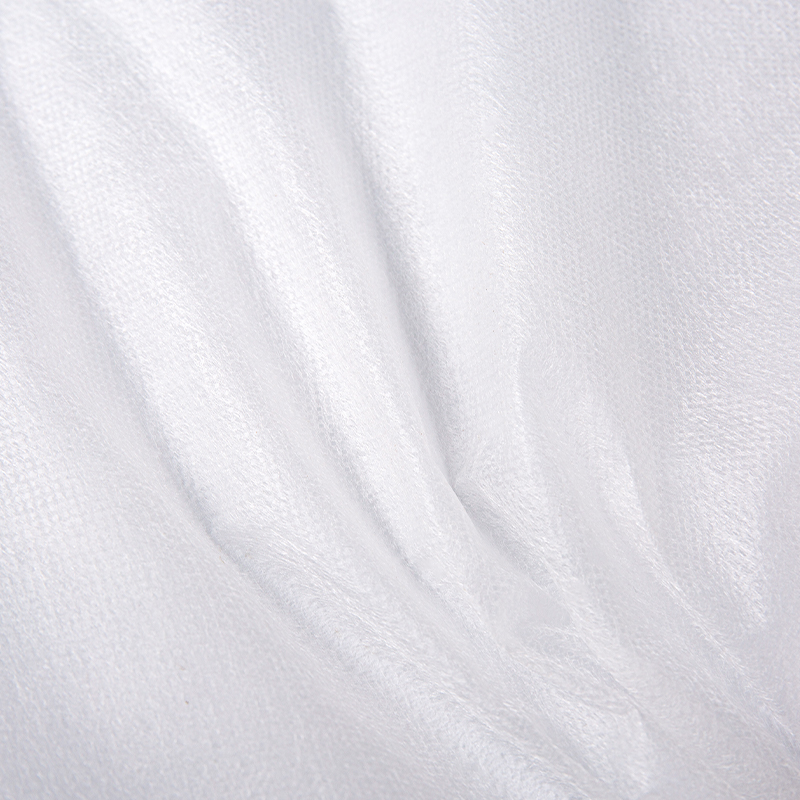 Checkered Spunbond Polypropylene Nonwoven Fabric for Medical MasksThis checkered spunbond PP fabric provides the durable outer layer for medical masks, offering strength, breathability, and basic filtration. It suits healthcare and public settings where stable structure and comfort are essential.View Product →
Air and Liquid Filtration
HVAC filters, cleanroom panels, vehicle cabin filters, and industrial baghouse filters all rely on meltblown as the depth filtration layer. In liquid service, polypropylene meltblown cartridges are common in water, beverage, and chemical filtration because the media is chemically inert and a cartridge can be disposed of complete, eliminating the handling issues of glass or ceramic elements.
Hygiene Products and Industrial Sorbents
Baby diapers and feminine hygiene products use meltblown in acquisition and distribution layers that pull fluid away from the skin and spread it into the absorbent core. Because polypropylene is oleophilic, meltblown pads and rolls are the standard response to oil spills on water and plant floors; a typical pad absorbs several times its own weight and continues to float.
Insulation and Energy Components
Meltblown also appears as acoustic and thermal insulation in appliances, vehicles, and building panels, and as fine-pore separator layers in lithium battery cells. Every one of these uses exploits the same trait: a very large surface area packed into a thin, light, low-cost web.
Meltblown vs Spunbond vs SMS: How to Choose the Right Structure
Choose meltblown when the job is filtration or absorption, choose spunbond when the job is structural strength, and choose an SMS laminate when the material must do both at once.
Meltblown alone is too soft and too weak for sewn or high-wear products, so it almost never appears as the exterior surface of a finished article. Spunbond polypropylene is the workhorse of shopping bags, luggage panels, sofa lining, and agricultural covers, and in those markets surface pattern matters as much as mechanical strength: checkered and cross-pattern PP spunbond fabrics are routine specifications for bag and upholstery converters. When barrier and strength are required together, the standard answer is SMS (spunbond-meltblown-spunbond), a three-layer composite produced on a single multi-beam PP non-woven fabric making machine.
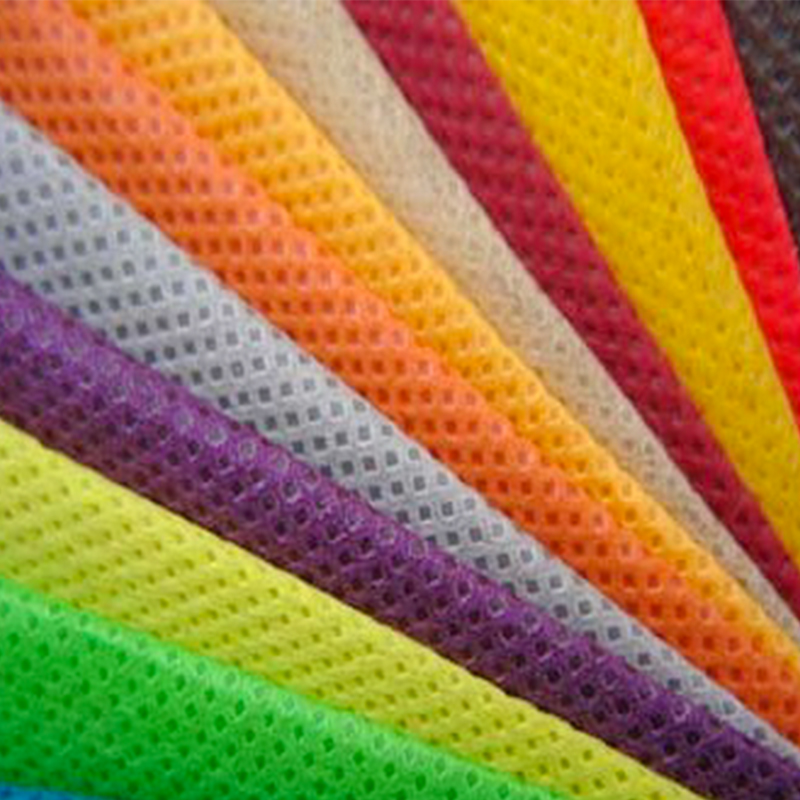 Checkered Colored Polypropylene Spunbond Fabric for Luggage BagsThis patterned spunbond PP fabric delivers tear resistance and flexibility for luggage bag cores. Its checkered texture adds friction and visual appeal, while color customization supports branding for bags and packaging applications.View Product →
Specify meltblown when
- Particle filtration is the primary function
- High surface area per gram matters more than tear strength
- Electrostatic capture can be employed
- The web will be framed, sealed, or laminated for support
Specify spunbond when
- Tear and puncture resistance dominate the design
- Printability and roll-to-roll pattern are required
- The material will be sewn, folded, or die-cut
- Cost per square meter must stay low
The most common sourcing error is comparing meltblown and spunbond on the same axis. Meltblown is not a weaker version of spunbond; it is a different material logic. A spunbond web buys strength and hand feel, while a meltblown web buys fine particle control. They are complementary, and SMS exists because of that complementarity.
How to Select the Right Meltblown Nonwoven Fabric
Three specification decisions determine most meltblown sourcing outcomes: the target filtration efficiency, the acceptable pressure drop, and the mechanical support the web will receive in the final product. Work through the following points in order before issuing a purchase specification.
- Define the particle challenge. Identify the target particle size, distribution, and whether the contaminant is solid, liquid, or bioaerosol.
- Reference a standard. EN 149 for respirators, ASTM F2100 for medical face masks, ISO 29463 for HEPA-grade media.
- Balance basis weight against pressure drop. Thicker webs capture more but add breathing resistance and cost.
- Verify electret charge retention. Charged media loses efficiency after hot, humid storage; ask for charge stability data.
- Inspect web uniformity. Pinholes and basis weight streaks create preferential airflow paths and failure spots.
- Confirm converting behavior. Pleating, lamination, slitting, and die-cutting each set a minimum mechanical requirement on the web.
Frequently Asked Questions About Meltblown Nonwoven Fabric
Is meltblown nonwoven fabric the same as spunbond nonwoven fabric?
No. Meltblown uses high-speed hot air to draw fibers down to 0.5-10 microns, while spunbond draws thicker filaments that form a stronger, more open web. Different dies, different fiber diameters, and different end uses.
What makes meltblown effective in medical masks?
The combination of fine fibers and electret charging. The microfiber web blocks particles mechanically, and the electrostatic charge attracts sub-micron particles that would otherwise pass through the open pores.
What basis weight is typical for filtration-grade meltblown?
Respirator filtration layers usually run from 20-40 gsm, while HVAC and coalescing media are often specified at 50-150 gsm, depending on the efficiency target and the allowed pressure drop.
Can meltblown polypropylene be recycled?
Yes. Clean meltblown scrap and post-industrial web can be compacted, re-extruded, and returned to the polymer stream, provided the melt flow index is consistent. Heavy colorant or additive loading reduces the value of the recycled fraction.




