

 English
 русский
 Español

How Is PP Spunbond Nonwoven Fabric Manufactured? From Polymer to Finished Roll
Home / News / Industry News / How Is PP Spunbond Nonwoven Fabric Manufactured? From Polymer to Finished Roll
The question "How is PP spunbond nonwoven fabric manufactured?" deserves a concrete answer, because the polymer-to-roll sequence decides everything a buyer will measure later: basis weight uniformity, tensile strength, softness, and the embossed pattern on the surface. The entire transformation happens on one continuous line — PP spunbond nonwoven fabric starts as translucent resin pellets and reaches the winder in minutes, not days.
Spunbond nonwoven manufacturing is a single-step, in-line process that extrudes molten polypropylene into continuous filaments, lays the filaments into a random web, and thermally bonds the web into fabric. Because nothing is woven or knitted, the fabric is manufactured directly from polymer, which keeps the process fast, automated, and comparatively low-cost.
Content
The polymer grade is the first quality lever. A spunbond line cannot compensate for a resin with the wrong flow behavior, because the melt flow index (MFI) sets the entire processing window. Manufacturers use polypropylene homopolymer with an MFI of roughly 25 to 40 g/10 min. The material melts near 165 °C and runs at melt temperatures between 220 and 260 °C.
Additives are handled as masterbatch — pigments, UV stabilizers, antistatic agents, or hydrophilic finishes — metered into the hopper at 0.5 to 5% by weight. A dosing unit blends the masterbatch continuously so that color and functional properties stay uniform across the whole roll, a detail that becomes critical when the same fabric must match across multiple production shifts.
Melt flow index (MFI) is the number of grams of molten polymer that pass through a standardized die in 10 minutes under a fixed load and temperature. A higher MFI means lower melt viscosity, which produces finer filaments but demands tighter temperature control along the die.
| Parameter | Typical value | Effect on the process |
| Melt flow index | 25–40 g/10 min | Lower viscosity enables finer filaments and higher throughput |
| Melting point | 160–165 °C | Defines the extrusion and bonding temperature window |
| Masterbatch loading | 0.5–5% by weight | Adds color, UV resistance, or water repellency |
| Moisture content | Below 0.1% | Prevents viscosity swings and spinneret surface deposits |
A stable, particle-free melt stream is the precondition for a uniform web. Any pulse in the melt shows up later as a thickness streak or a soft spot in the roll.
The extruder melts the resin at 220–260 °C. The melt then passes through a screen changer or filter pack, typically 40 to 120 mesh, that removes gels and contaminants, and a gear pump meters a constant volumetric flow toward the die. The die distributes the melt across the full line width — from 1.6 m to 3.2 m on the production lines built and operated by Jiangyin Jingang Non-Woven Co., Ltd. — so every filament zone receives the same throughput.
Process tolerance: a melt temperature drift of ±5 °C at the die can change filament diameter and create a visible basis-weight variation across the web. Modern lines monitor die pressure, pump speed, and zone temperatures to hold the melt profile steady.
Filament fineness — normally 1.5 to 3 denier — is decided by the combination of quench air and drawing speed, not by the spinneret hole size alone.
The melt leaves the spinneret through several hundred to several thousand fine capillaries. An air-quench system cools the fresh filaments, while high-velocity drawing air stretches them. The cooled, attenuated filaments are laid onto a moving forming belt, whose suction holds them as a random, entangled web ready for bonding.
Bonding temperature and the engraved roll pattern determine tensile strength, hand feel, and surface texture. The loose web passes between heated calender rolls — typically one smooth roll and one engraved roll — and localized heat plus pressure fuses filaments only where the raised pattern lands. Standard bond areas run from 12 to 25% of the web surface; more bond area increases strength and stiffness, while less keeps the cloth soft.
The engraved pattern also produces the familiar surface effects that converters specify — the checkered, sesame, cross, and printed looks seen on luggage, sofa lining, bags, and interlining products.
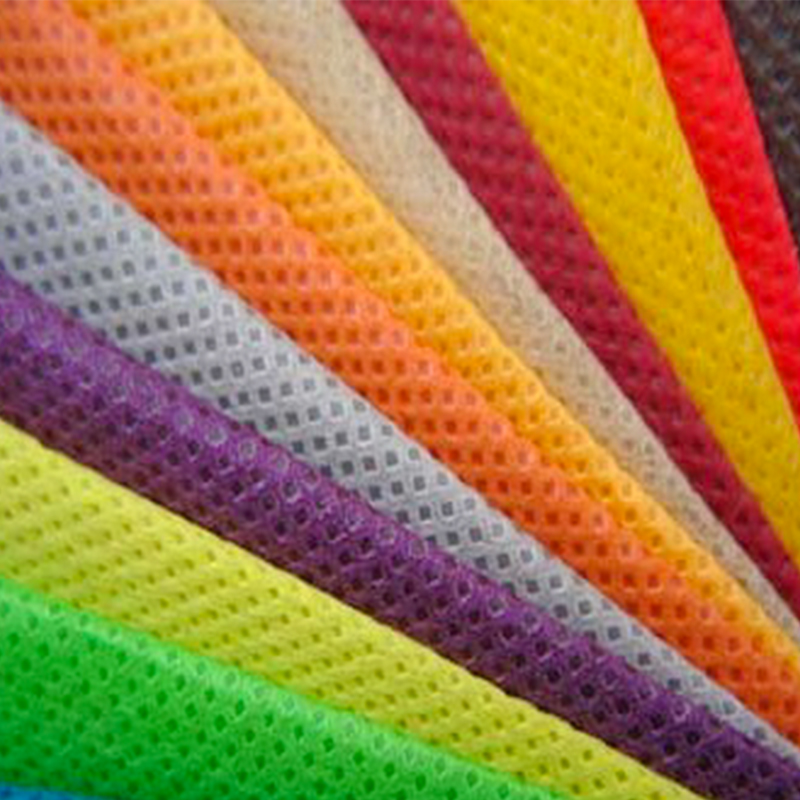 Checkered Colored PP Spunbond Nonwoven Fabric for Luggage BagsThis durable polypropylene nonwoven features a checkered texture that enhances grip and visual appeal, making it a reliable core layer for luggage, shopping bags, and interlining applications.View Product →
Bond area at a glance: 12–25% of the web is fused at the calender. Below 12%, delamination risk rises; above 25%, the fabric becomes stiff and loses drape.
The finishing section separates a commodity parent roll from a ready-to-convert product. After bonding, the line can run corona treatment to raise surface energy and improve printability, apply chemical finishes such as antistatic, hydrophilic, or flame-retardant treatments, and dry the web.
For printed grades, the finishing section integrates a printing station after corona treatment; gift-wrap and shopping-bag rolls are produced this way in widths matched to the converter's slitting plan. The winder then builds a parent roll at controlled tension, a slitting station cuts it to exact widths, and inline inspection flags basis-weight, pinhole, and edge defects before packing.
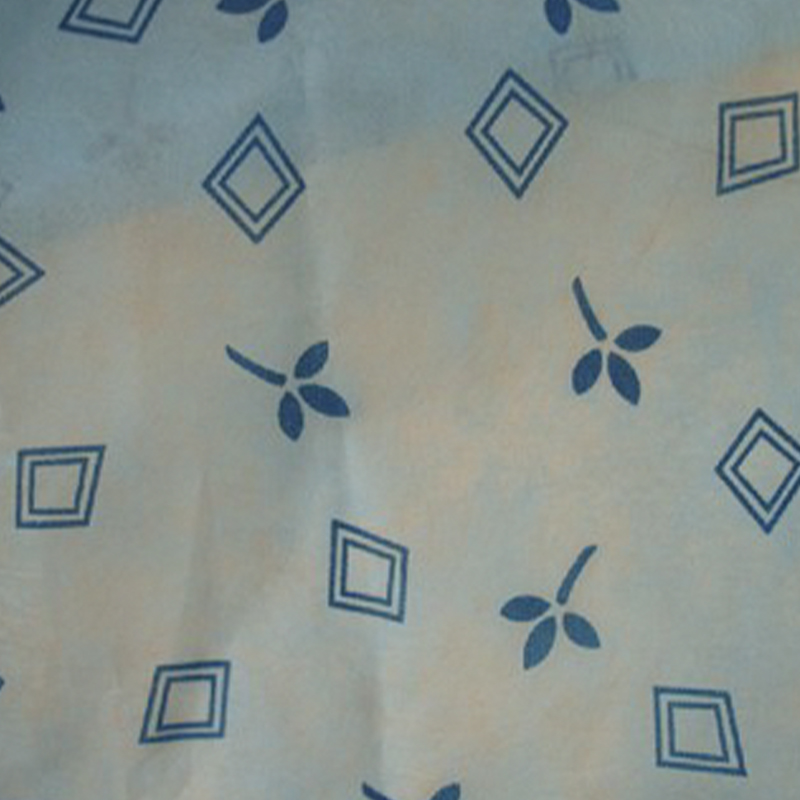 PP Printed Spunbond Nonwoven Fabric for Gift PackingThis printed polypropylene nonwoven offers vibrant, customizable patterns and tear-resistant flexibility, ideal for gift wrapping and branding while maintaining cost-effective, eco-friendly packaging performance.View Product →
QC at the roll stage: samples are pulled per shift to verify basis weight, MD/CD tensile strength, elongation, hydrostatic head, and roll hardness. Certificates of analysis travel with each roll so the buyer can verify the same values the operator monitored.
Each conversion point has its own thermal window, and the melt spends most of its thermal history at two opposite extremes — molten in the extruder, then rapidly quenched in the spin zone.
Faster quench produces finer filaments, but only when polymer flow upstream is uniform — which is why filtration and metering sit directly before the spinneret.
Rule of thumb: keep the die within ±5 °C of the melt temperature and the calender within ±3 °C across the roll face. Thermal drift at either point tends to appear as cloudiness, hard streaks, or a calender-mark repeat in the finished roll.
The same parameters operators monitor are the ones buyers should verify on a certificate of analysis or a machine specification sheet. For fabric buyers, that means basis weight tolerance, the MD/CD tensile ratio, and the embossed pattern. For plants planning capacity, the starting point is the relationship between line width, fabric weight range, and floor space.
| Line width | Typical basis weights | Best fit | Main trade-off |
| 1.6 m | 10–150 g/m² | Pilot runs, specialty finishes, narrow orders | Lower output per hour |
| 2.4 m | 10–150 g/m² | Mid-size converters balancing flexibility and volume | Medium throughput |
| 3.2 m | 15–150 g/m² | High-volume parent rolls for slitting | Larger minimum runs |
Jiangyin Jingang Non-Woven Co., Ltd., operating since 1999, developed its German-style spunbond technology in 2002 and has since run fabric production and machine building side by side. When you discuss a project with the team, you can compare a PP non-woven fabric making machine specification against fabric samples produced on the same type of line — a short-loop way to validate quality before committing to equipment.
Short, direct answers to the questions buyers ask most often after reading a process description.
Polypropylene homopolymer resin with a melt flow index of roughly 25–40 g/10 min. Pigments, UV stabilizers, and functional additives are introduced as masterbatch during the extrusion step.
Ten to twenty minutes from hopper to winder on a continuous line. Total cycle time is dominated by the inline quality checks and roll handling at the end of the line, not by the polymer conversion itself.
Most lines run 10 to 150 g/m² without a major changeover. Light grades near 10 g/m² are used in agriculture and packaging, while heavy grades are typical for furniture lining and industrial applications. Below 10 g/m², web uniformity becomes difficult; above 150 g/m², spunmelt or needlepunch processes take over.
Resin quality, bond pattern, basis-weight tolerance, and finishing steps — corona, printing, chemical treatments — explain most of the difference. A cheaper roll may simply be produced to wider tolerances, so verify the certificate of analysis before comparing prices.
The question "How is PP spunbond nonwoven fabric manufactured?" deserves a concrete answer, because the polymer-to-rol...
READ MOREIn garment production, interlining defects surface late and cost money: a collar that bubbles after fusing, a lapel th...
READ MOREPlain spunbond polypropylene fabric slides. On a high-speed bag cutting line that means off-square panels, misaligned ...
READ MOREAt a packaging plant in eastern China, switching reusable shopping-bag production from woven polypropylene to PP spunb...
READ MOREWhen a surgical mask specification requires a filtration layer that stops sub-micron particles, or an HVAC filter desi...
READ MORE




